Blog

  • NMC Guidelines 2026: What They Mean for Healthcare Digital Marketing in India

    NMC Guidelines 2026: What They Mean for Healthcare Digital Marketing in India

    NMC Guidelines 2026: what they mean for healthcare digital marketing in India

    On 6 October 2026, the National Medical Commission (NMC) released its Guidelines on Ethical Advertising and Public Communication by Hospitals/Medical Institutions and Registered Medical Practitioners. They came into force immediately. There was no grace period.

    Healthcare marketing in India has changed significantly with the rise of digital platforms. Patient testimonials, before-and-after photos, “best hospital in the city” claims, influencer-led promotion and festive health offers have become increasingly common ways for hospitals, clinics and doctors to attract attention and patients. Much of this promotional playbook is now facing tighter restrictions.

    For doctors, the consequences can also be serious: repeated breaches of professional advertising rules can lead to disciplinary action, including removal from the medical register for a specified period.

    Healthcare marketing itself isn’t banned. But the boundaries around how doctors, hospitals and clinics can promote their services have become much clearer, and more restrictive. This guide explains what the new NMC guidelines say, what they mean for healthcare marketing, and how hospitals and healthcare brands can continue building visibility and trust while staying compliant.

    Why did the NMC introduce these guidelines?

    The NMC’s tighter approach to healthcare advertising comes against a broader regulatory backdrop, including Supreme Court scrutiny of misleading advertising in healthcare. Doctors were already restricted from self-promotion under the 2002 professional conduct regulations, but the rules were less clear when it came to hospitals and third-party marketers. The new framework aims to apply more consistent standards across doctors, hospitals and those marketing healthcare on their behalf.

    The NMC’s stated goals are to:

    • Protect patients from misleading claims
    • Prevent the commercialisation of healthcare
    • Keep health communication factual and evidence-based

    Who do the NMC guidelines apply to?

    The guidelines cover:

    • Registered medical practitioners (RMPs): every doctor registered with the NMC or a State Medical Council
    • Hospitals, clinics and medical institutions: across all recognised systems of medicine
    • Healthcare platforms: those that list doctors
    • Agencies, digital marketing agencies and influencers: indirectly, through the doctors and hospitals they work for

    They apply to every medium: websites, social media, WhatsApp and other messaging apps, podcasts, print, TV, radio, hoardings, influencer content, sponsored posts and AI-generated content.

    7 big changes for healthcare marketing
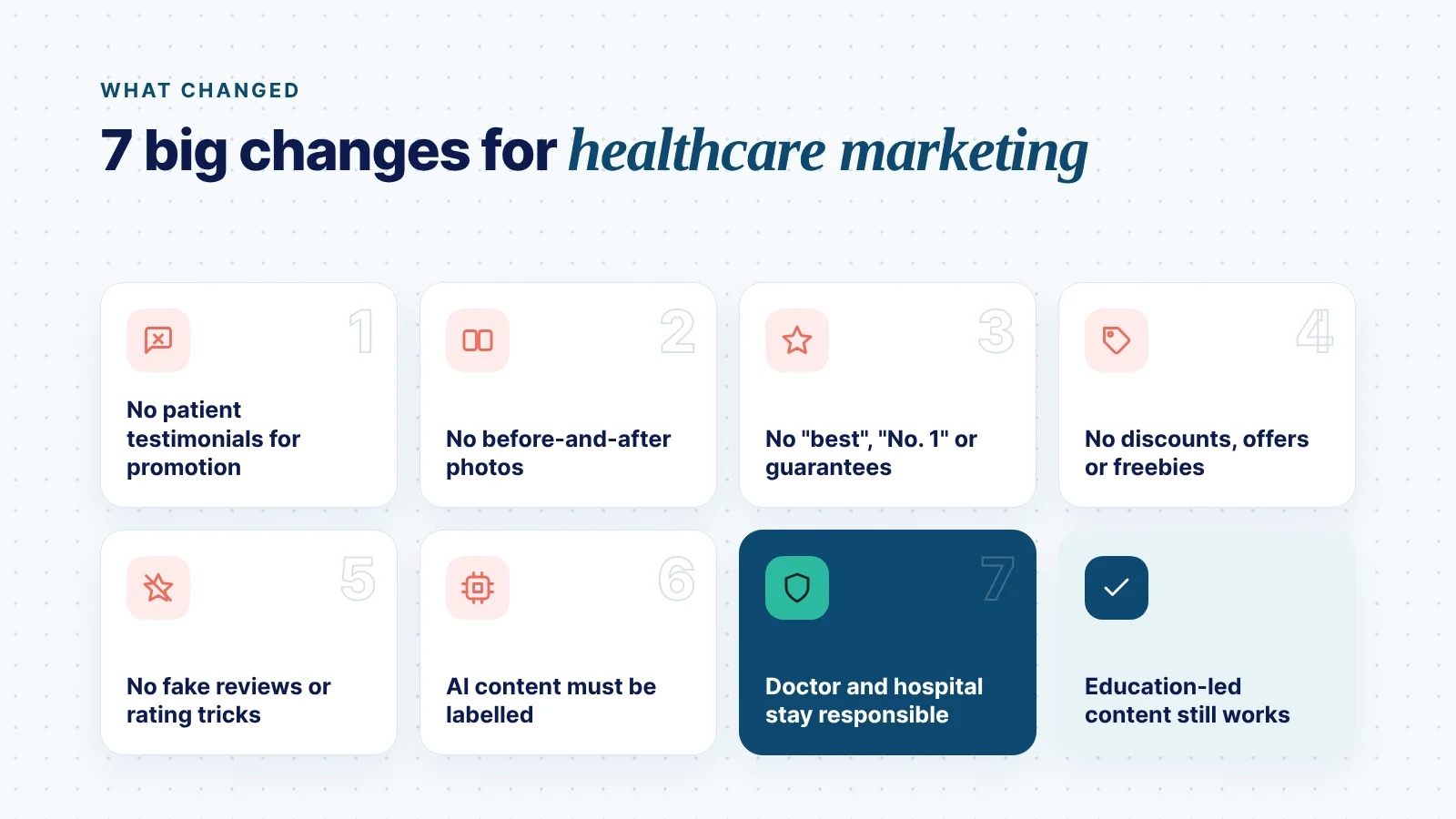
    7 big changes the NMC guidelines bring to healthcare marketing

    1. Patient testimonials can’t be used for promotion

    Testimonials from patients, staff, celebrities or influencers can’t be used to promote a doctor or hospital. Doctors also can’t request or share patient testimonials on social media for professional promotion.

    What this means for marketers: the “happy patient” video, long the most popular format in healthcare marketing, can no longer be used as promotion. Existing testimonial posts should be reviewed and removed or archived.

    2. Before-and-after photos and success stories are out

    Advertising surgical results, before-and-after photos, celebrity patients and promotional success stories is prohibited. Patient case material is allowed only for genuine scientific or educational purposes, with proper consent, and anonymised.

    What this means for marketers: cosmetic surgery, dental, dermatology, hair transplant and weight-loss marketing are especially affected. Showing results now requires a different, education-led approach.

    3. “Best,” “No. 1” and guaranteed results are banned

    Superlatives such as “best,” “No. 1,” “leading” and “most trusted” aren’t allowed unless they can be objectively verified. Claims like “guaranteed cure,” “100% success,” “painless treatment” and “miracle treatment” are prohibited outright.

    What this means for marketers: this goes beyond social media captions. Website headlines, ad copy and even SEO page titles such as “Best Eye Hospital in Chennai” need a second look.

    4. Discounts, offers and freebies are not allowed

    Discounts, limited-time offers, contests, coupons, cashbacks and free procedures that may encourage unnecessary care are prohibited. Prices can still be shared, as long as they are factual and transparent.

    What this means for marketers: festive campaigns like “Deepavali offer: 20% off on full-body check-ups” are no longer an option. Seasonal content has to shift from offers to awareness.

    5. Fake reviews and rating manipulation are clearly prohibited

    Soliciting, buying or manipulating fake, paid or misleading reviews and ratings is banned. So are fake followers and likes, and attempts to manipulate search rankings or algorithms.

    What this means for marketers: any tactic that inflates reviews or engagement is now a professional-conduct risk for the doctor, not just a platform violation.

    6. AI-generated content now has rules

    • AI-generated promotional campaigns for commercial purposes are prohibited.
    • AI content that is allowed must carry a clear label saying it was AI-generated.
    • AI must never be used to create or alter a patient’s face, voice, testimonial or treatment outcome, or to create fake endorsements.
    • Any patient data used in AI tools must comply with India’s privacy and data protection laws.

    What this means for marketers: AI avatars of “patients,” AI-written testimonials and synthetic doctor endorsements are off the table.

    7. Responsibility stays with the doctor and the hospital

    Content published through an agency, platform or influencer is still the responsibility of the doctor or hospital if they approved, commissioned or knowingly allowed it. Doctors can’t use third parties to do indirectly what they can’t do directly. Agency and influencer fees also can’t be tied to patient referrals.

    What this means for marketers: “the agency posted it” isn’t a defence. Hospitals need a proper review and approval process, and agency contracts shouldn’t use pay-per-patient models.

    What hospitals and doctors can still do

    The guidelines don’t stop healthcare providers from communicating. They require communication to be factual, educational and non-promotional. Here’s what remains allowed.
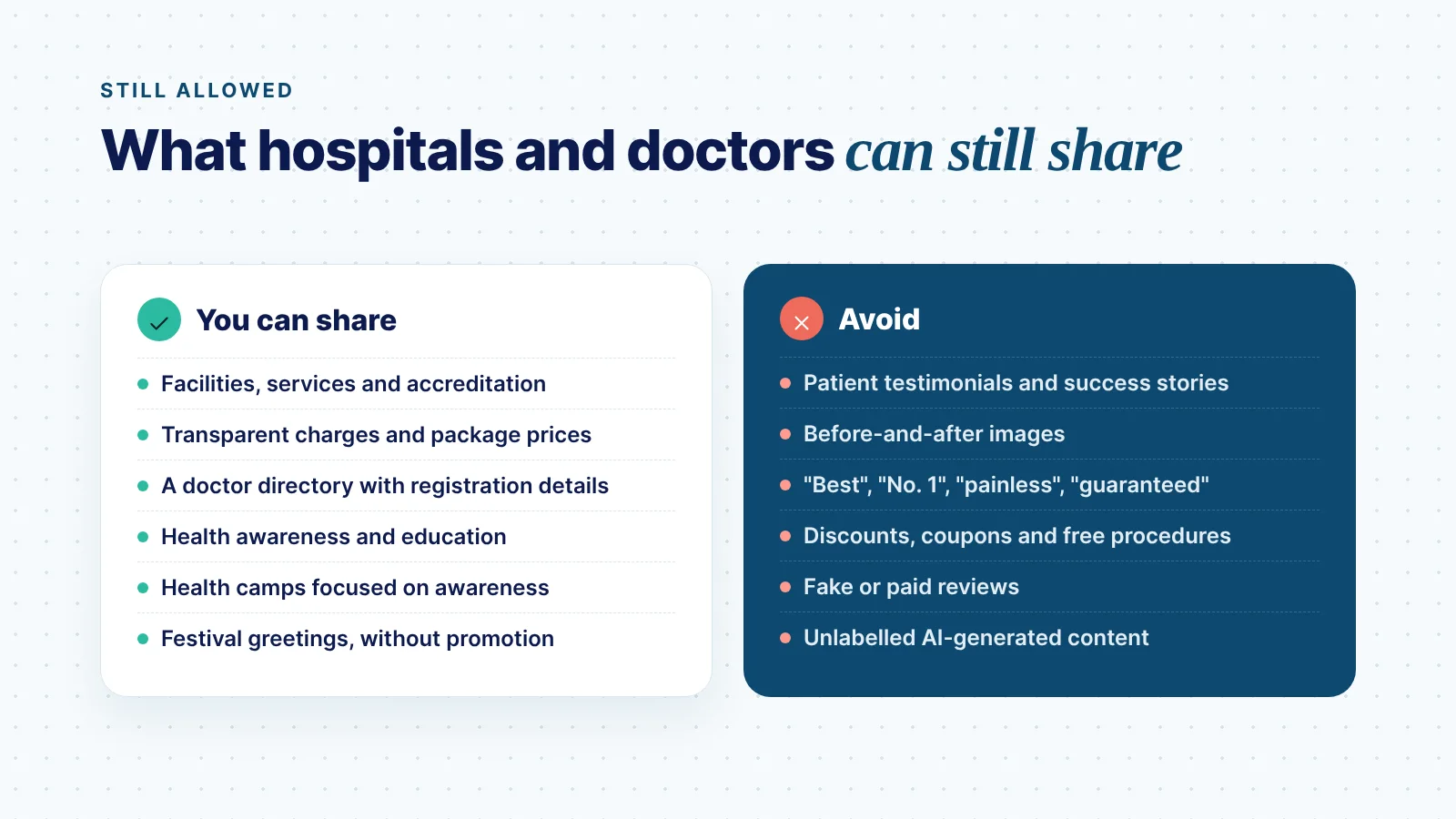
    What hospitals and doctors can still share under the NMC guidelines, and what to avoid
    What you can shareThe condition
    Facilities, departments, services, equipment and accreditationFactual, with no claims of superiority
    Location, contact details and timingsFactual
    Charges and package pricesTransparent and not misleading
    A doctor directory on your websiteNames, qualifications, specialities, registration details and availability
    Health awareness and educational contentMust not solicit patients or promote the practice
    Doctors on TV, radio, podcasts and talksIn their own name, without promoting their employer
    Health camps and public campaignsFocused on awareness, not patient acquisition
    Hoardings and billboardsFactual infrastructure and facility information
    AnnouncementsNew clinic, change of address, timings or fees
    Festival and national day greetingsWithout promotional content

    What every healthcare post must now include

    • Posts by doctors: must show the doctor’s name, qualifications and medical registration number.
    • Posts by hospitals and clinics: must name the doctors involved and their credentials.
    • Awards and rankings: must state who gave them, when and on what basis.
    • Commercial relationships: behind health content must be disclosed.
    • AI-generated content: must be labelled as AI-generated.

    Penalties under the NMC guidelines

    Action against doctors is taken by the State Medical Council and increases with each violation.
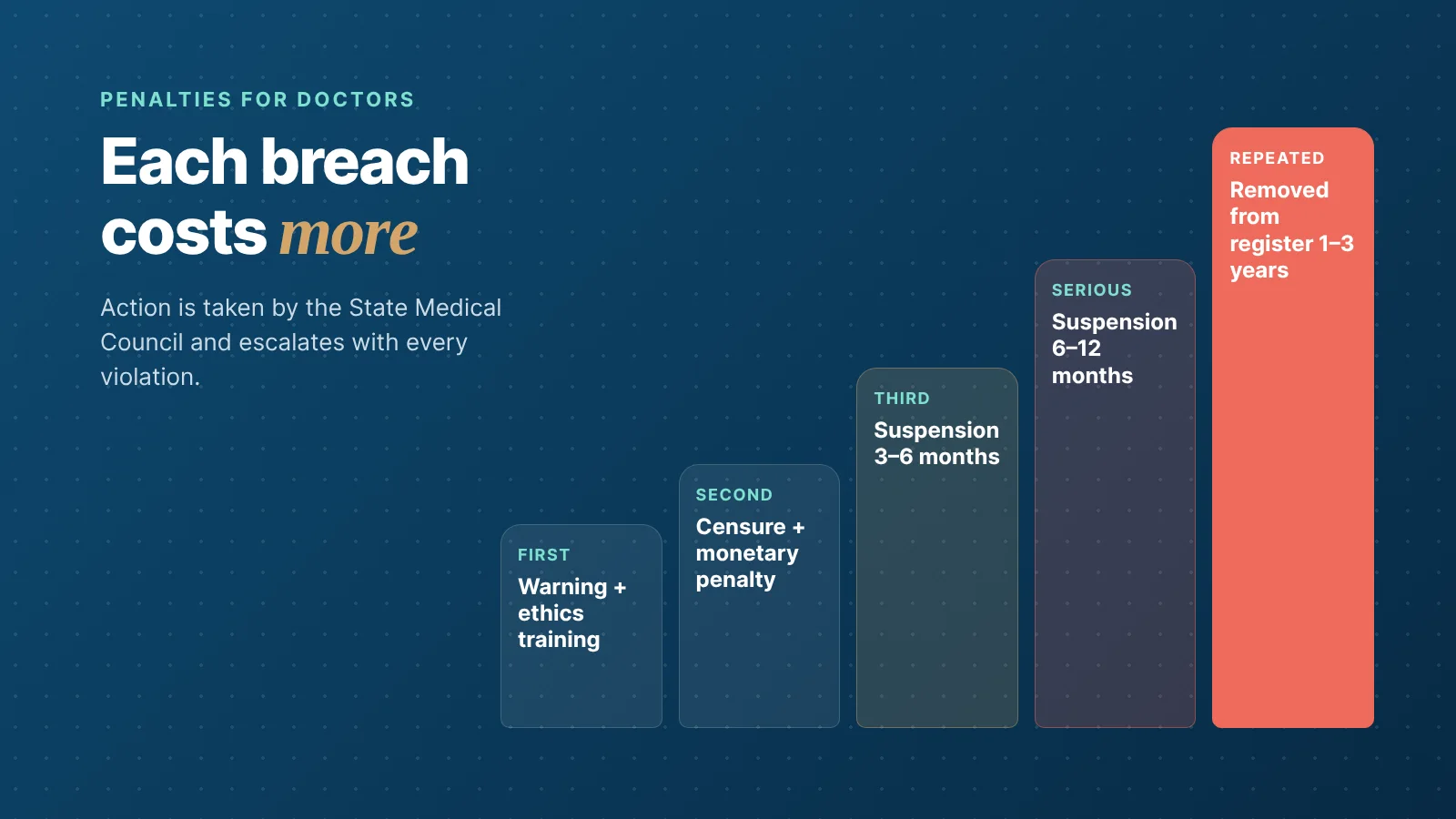
    Penalties for doctors under the NMC advertising guidelines, from warning to removal from the register
    ViolationPenalty
    FirstWarning and mandatory ethics training
    SecondCensure and a monetary penalty
    ThirdSuspension of registration for 3 to 6 months
    Serious (e.g. cure claims, inducements, mass digital solicitation)Suspension for 6 to 12 months
    RepeatedRemoval from the medical register for 1 to 3 years

    Doctors get a show-cause notice and a chance to respond before any penalty, and can appeal. Hospitals face action under the Clinical Establishments Act and applicable state laws.

    Grey areas to watch

    Some questions aren’t fully answered yet, and the NMC has said it may issue clarifications.

    • Paid ads and boosted posts: aren’t explicitly banned. However, the ad content must follow every rule above.
    • Asking patients for Google reviews: fake and paid reviews are clearly prohibited. Asking genuine patients for reviews isn’t directly addressed, so tread carefully and never offer incentives.
    • The line between education and promotion: a doctor explaining a condition is educational. Ending the same video with “book your appointment now” may cross into promotion.
    • Google Business Profile: isn’t named specifically, but as a public medium it should stay factual.

    The new healthcare marketing playbook

    Healthcare marketing now rewards trust built through information, not persuasion through claims. That’s a better foundation anyway: patients research before they choose a doctor, and expertise is what convinces them.

    Here’s what works within the rules:

    1. Education-led content: short videos and carousels explaining conditions, symptoms, prevention and when to see a doctor.
    2. Doctor-led awareness: doctors speaking in their own name about their speciality, with registration details shown, build credibility without self-promotion.
    3. Facility and process content: factual tours of departments, equipment and patient processes help patients know what to expect.
    4. Health awareness days and camps: use the health calendar (World Diabetes Day, Breast Cancer Awareness Month, World Sight Day) for awareness, not offers.
    5. Strong, factual websites: clear service pages, a complete doctor directory and transparent information about charges and timings.
    6. Local search visibility: an accurate, regularly updated Google Business Profile helps patients nearby find you.
    7. Consistency over claims: regular, helpful content builds familiarity. That’s what makes patients choose you, not superlatives.

    NMC compliance checklist: 10 questions to ask before you post

    Run every healthcare post, ad and web page through these questions:
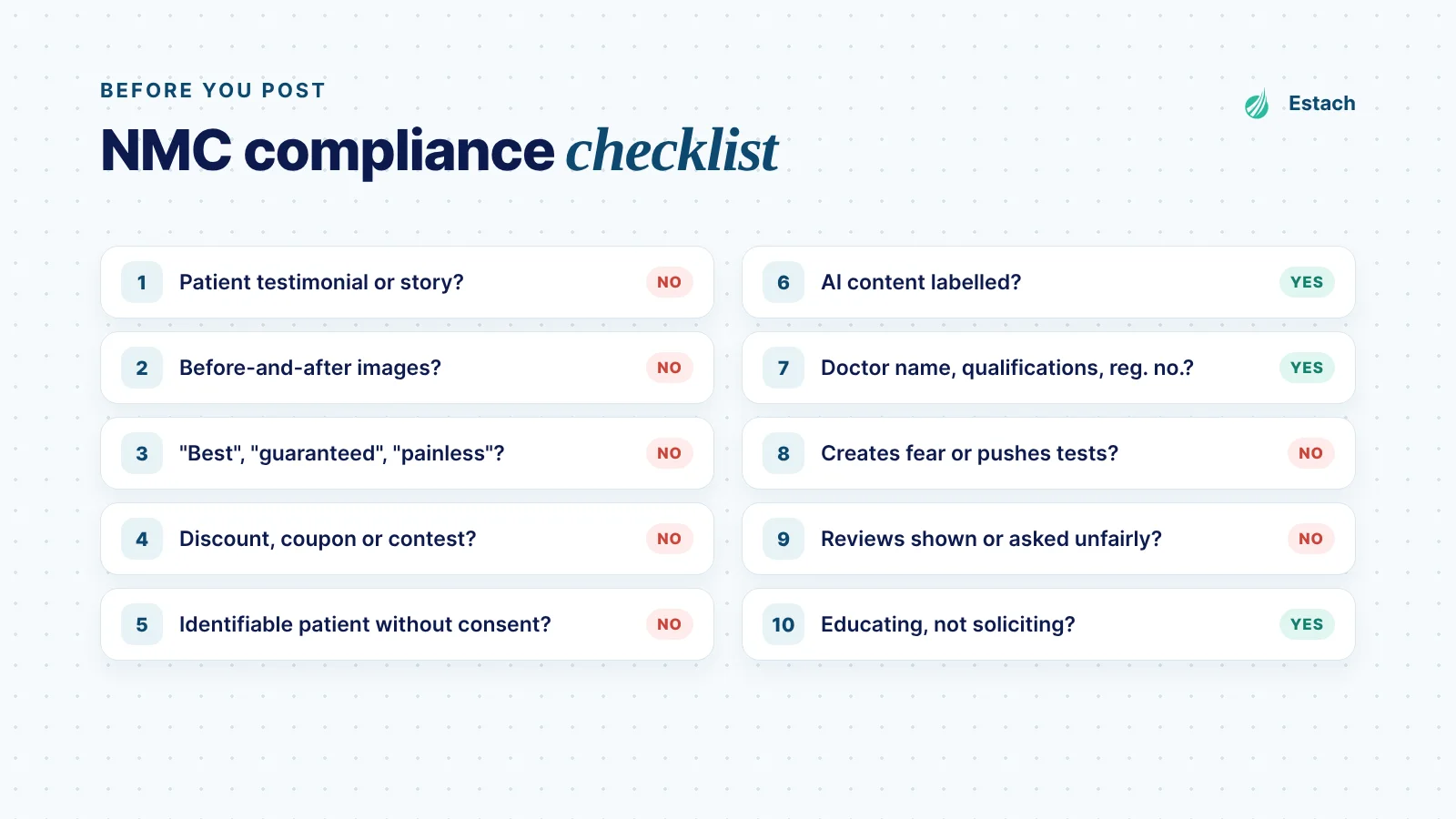
    NMC compliance checklist: 10 questions to ask before publishing a healthcare post
    1. Does it include a patient testimonial or patient story?
    2. Does it show before-and-after images or treatment results?
    3. Does it use words like “best,” “No. 1,” “leading,” “guaranteed” or “painless”?
    4. Does it offer a discount, free procedure, coupon or contest?
    5. Does it show an identifiable patient without legal basis and consent?
    6. Is any part AI-generated, and if so, is it labelled?
    7. Does it show the doctor’s name, qualifications and registration number?
    8. Could it create fear or push someone toward an unnecessary test or procedure?
    9. Is the ad or post asking for, or showing, reviews in a way that could be seen as manipulation?
    10. Is it educating, or is it soliciting patients?

    If the answer to any of questions 1 to 5, 8 or 9 is yes, or to 6 or 7 is no, revise the post before it goes live.

    How Estach can help

    Estach has helped healthcare providers build their digital presence. For a multi-speciality hospital, that meant 1.5M+ video impressions and 600K+ interactions in 90 days. The new guidelines change how that work is done, not whether it can work.

    We help hospitals, clinics and doctors with:

    • Compliance audits: of existing social media, websites and ads
    • Compliant content strategies: built around education and doctor-led awareness
    • Website and service page updates: that are factual and still convert
    • Local search: and Google Business Profile optimisation
    • Approval workflows: so every post is reviewed before it goes live

    Is your healthcare marketing compliant?

    Book a free NMC compliance check with Estach. We’ll review your social media, website and ads, flag anything that may break the new guidelines, and show you how to keep growing within the rules. Book your free compliance check or call us at +91 91506 60660.

    This article is for general information only and isn’t legal advice. For decisions specific to your practice, please consult a qualified legal or compliance professional.

    Frequently asked questions

    When did the NMC advertising guidelines come into effect?

    The guidelines were issued on 6 October 2026 and came into effect immediately, with no transition period for existing content.

    Do the NMC guidelines apply to hospitals or only to doctors?

    Both. They apply to registered medical practitioners and to hospitals, clinics and medical institutions. Hospitals face action under the Clinical Establishments Act and state laws.

    Can doctors still post on Instagram and other social media?

    Yes. Doctors can share educational and health awareness content. Posts must not solicit patients or promote the practice, and must show the doctor's name, qualifications and registration number.

    Are patient testimonials allowed under the new NMC rules?

    No. Patient testimonials can't be used for promotion, and doctors can't request or share patient testimonials on social media for professional promotion.

    Can hospitals run discounts or health check-up offers?

    No. Discounts, limited-time offers, coupons, cashbacks and free procedures are prohibited. Hospitals can still publish factual, transparent prices.

    Can hospitals still run paid ads?

    Paid ads aren't explicitly banned, but every ad must follow the content rules: no superlatives, no guarantees, no testimonials, no offers and no patient solicitation.

    Is the agency responsible if a post breaks the rules?

    Under the guidelines, the doctor or hospital remains responsible for content they approved, commissioned or knowingly allowed, even if an agency or influencer published it.
  • How to Choose a Digital Marketing Agency in Chennai: 10 Questions to Ask Before You Sign

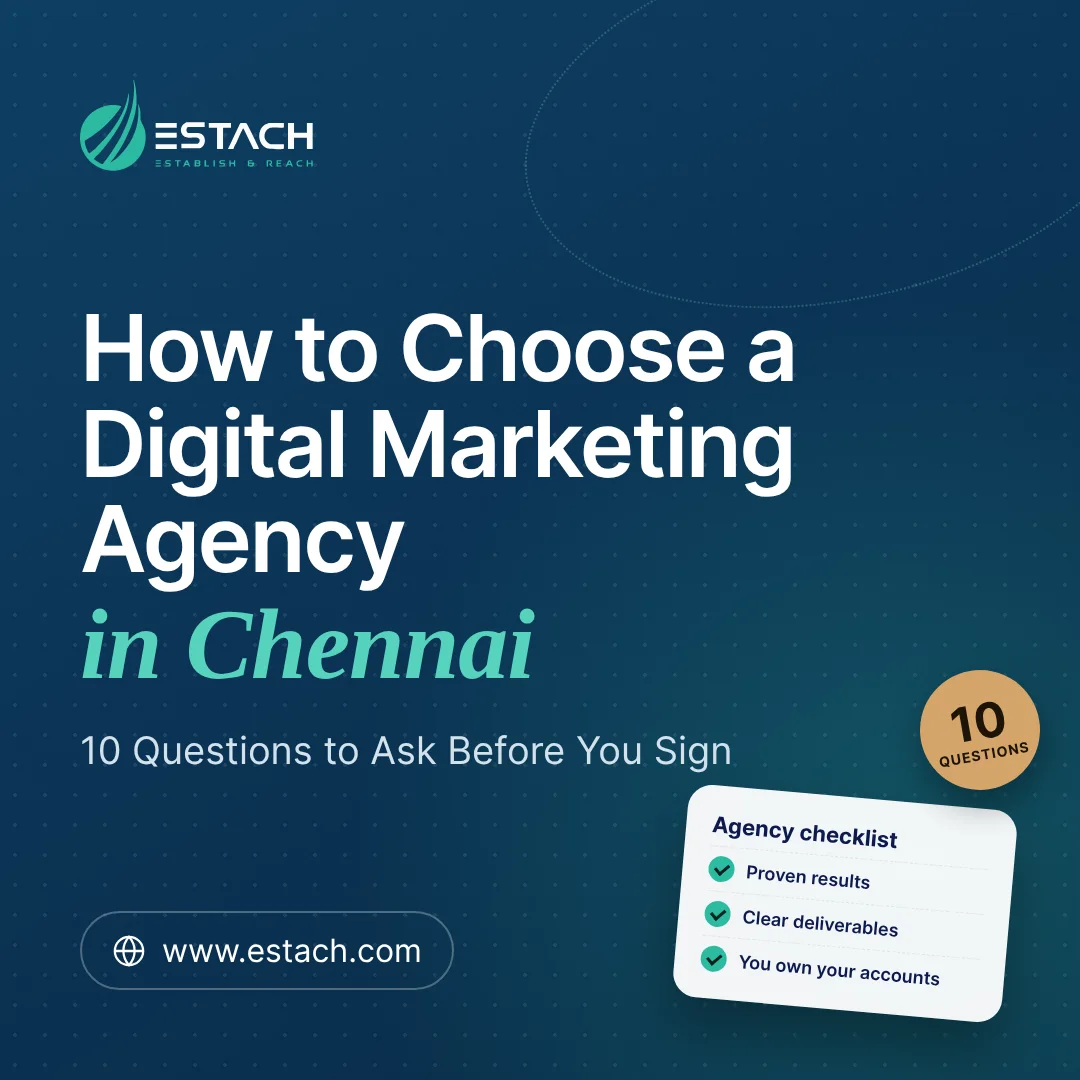
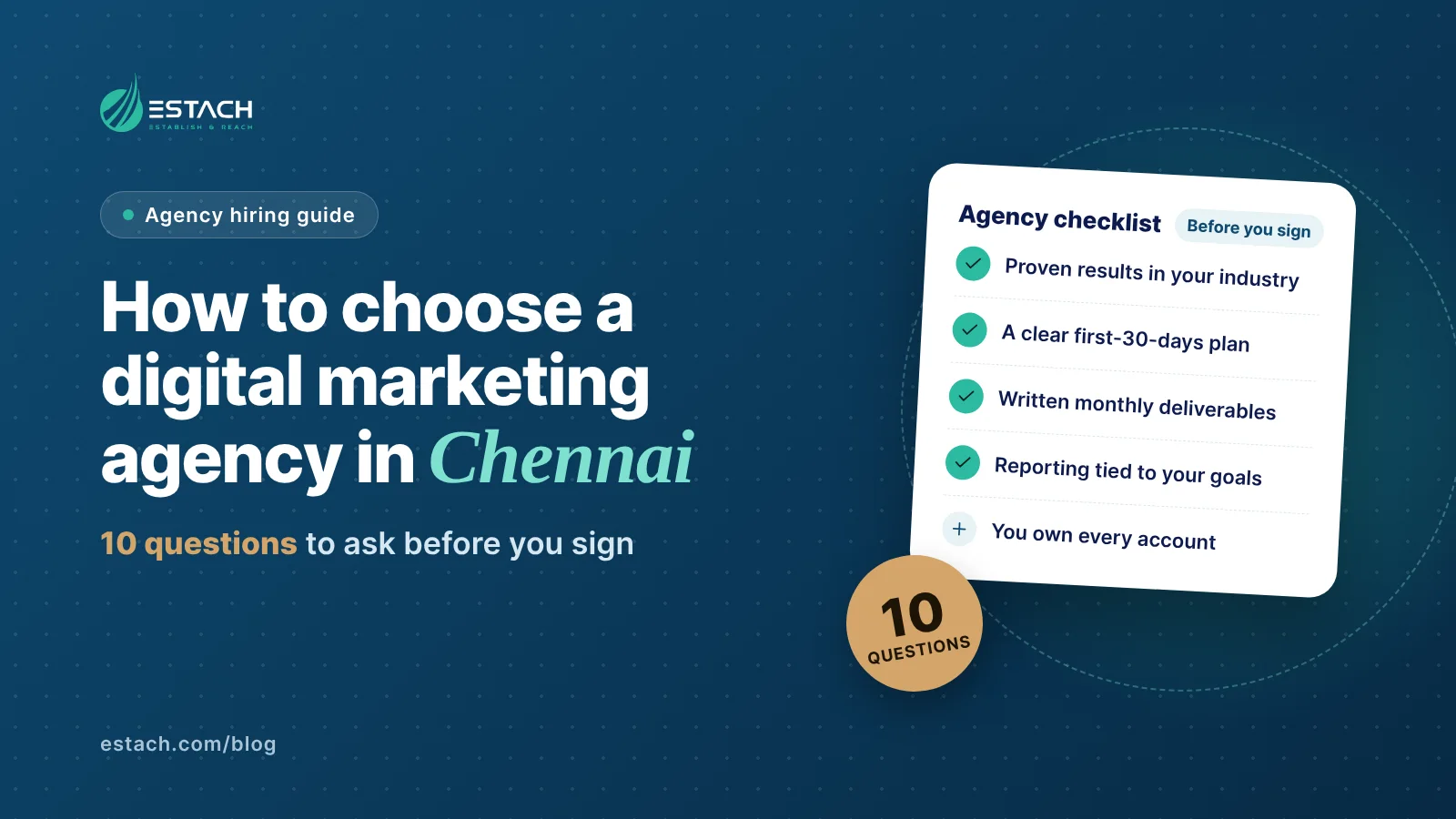
    How to Choose a Digital Marketing Agency in Chennai: 10 Questions to Ask Before You Sign

    How to choose a digital marketing agency in Chennai: 10 questions to ask before you sign

    India’s digital advertising market is growing rapidly. According to the Pitch Madison Advertising Report 2026, expanded digital advertising expenditure is projected to reach ₹1,11,976 crore in 2026, up from ₹93,156 crore in 2025. This broader estimate includes digital advertising by MSMEs and quick-commerce platforms.

    Small and medium-sized businesses are also playing an increasingly important role in this growth. The report forecasts India’s MSME digital advertising expenditure to reach ₹42,976 crore in 2026, representing approximately 20% growth over the previous year.

    For business owners, these numbers highlight an important consideration: success isn’t just about investing in digital marketing; it’s about investing strategically. Before partnering with an agency, understand what it will deliver, why its approach suits your business, and how it will measure success.

    Search “digital marketing agency in Chennai” and you’ll find hundreds of options. Most websites promise the same things: more followers, more leads, more growth. Many look polished. Prices vary widely.

    So how do you tell a real growth partner from someone who will post a few graphics, send a monthly PDF and disappear?

    At Estach, we hear this question on almost every strategy call. Many business owners come to us after a bad experience with another agency. They paid for months and couldn’t say what they got for it.

    This guide is the checklist we wish every business owner had before hiring anyone, including us.

    Before you start: know what you want

    Agencies can’t hit a target you haven’t set. Before your first call, write down answers to three questions:

    1. What does success look like in 6 months? More sales enquiries? Site visits for your project? Admissions? Online orders? Be specific.
    2. Who is your customer? Their age, location, and what they worry about before buying from you.
    3. How much time can you give? An hour a week? Four hours a month? Be honest. It decides what kind of agency you need.

    With these answers, every agency conversation becomes sharper, and you’ll spot vague answers immediately.

    10 questions to ask a digital marketing agency in Chennai

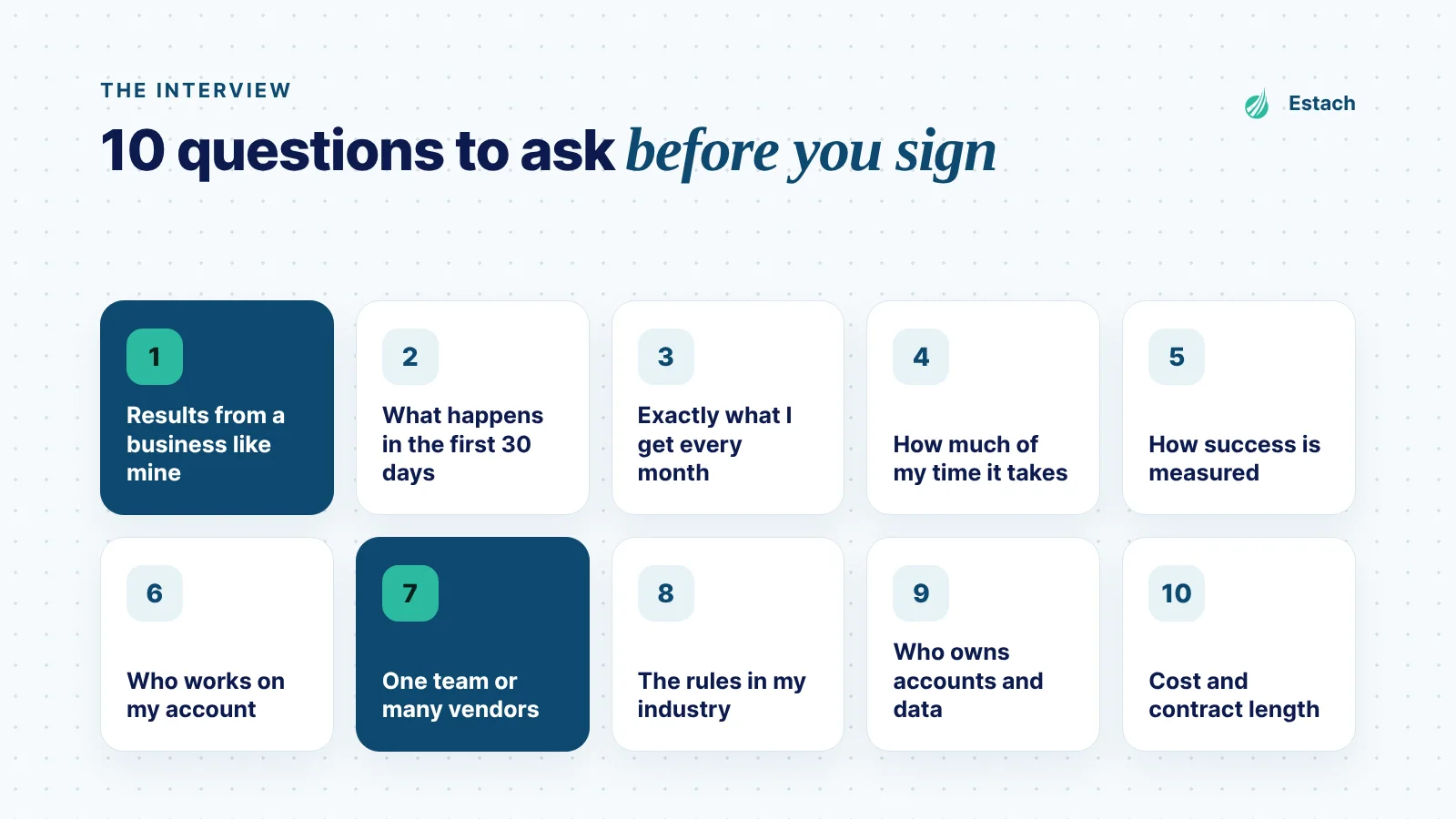
    The 10 questions to ask a digital marketing agency in Chennai before signing a contract

    1. Can you show me results from a business like mine?

    This is the most important question. An agency that has grown a hospital’s reach may not know how to sell flats, and vice versa.

    Ask for numbers, not adjectives. “We increased engagement” means nothing. “1.5M+ video impressions and 600K+ interactions in 90 days for a multi-speciality hospital” is something you can judge.

    Good sign: Case studies with real client names, numbers and timeframes, plus a client you can call.

    Red flag: Only logos, no results, or “our work is confidential.”

    2. What happens in the first 30 days?

    A good agency starts with strategy: understanding your business, your audience, competitors and goals. Posting comes after.

    Good sign: A clear onboarding plan covering a brand and competitor audit, content direction and a calendar, before anything goes live.

    Red flag: “We’ll start posting from day one.”

    3. Exactly what do I get every month?

    “Social media management” can mean 4 posts or 30. It might include videos, or just static graphics.

    Ask for a written list of deliverables:

    • How many posts, reels and stories
    • Who writes the scripts
    • Whether video shooting and editing are included
    • Which platforms are covered
    • Whether ad management is included or extra

    Red flag: A monthly fee with no clear scope.

    4. How much of my time will this take?

    This is the question most business owners forget to ask, and the main reason marketing stalls. If you run a clinic, a construction business or a school, you don’t have hours every week to brief, approve and shoot.

    The best agencies design around your schedule. One builder we work with spends about 4 hours a month with us. We handle strategy, script preparation, video shoots and posting.

    Good sign: A clear process for shoots, approvals and feedback that respects your time.

    5. How will you measure success, and how often will I see it?

    Followers and likes feel good, but they don’t pay salaries. Ask how the agency connects its work to your goals: enquiries, calls, walk-ins, admissions or sales.

    Good sign: Agreed goals up front, regular reporting, and an honest explanation when something isn’t working.

    Red flag: Reports full of vanity metrics with no link to business results.

    6. Who will actually work on my account?

    Some agencies win clients with senior people, then hand the work to a junior or a freelancer you never meet.

    Ask who your strategist is, who writes, who designs and edits, and who to call when something goes wrong.

    7. Do you handle everything, or will I need other vendors?

    Your social media, website, Google presence and ads should work together. When each is handled by a different vendor, the message gets inconsistent and no one owns the results.

    Good sign: One team that can connect content, search visibility, campaigns and your website into one plan.

    8. Do you understand the rules in my industry?

    Every industry has its own rules, and a good agency knows them.

    Healthcare is the clearest example. In October 2026, the National Medical Commission (NMC) issued new guidelines on how doctors and hospitals can advertise and communicate online. Patient testimonials, before-and-after images and claims like “best doctor” are now restricted. Responsibility stays with the doctor or hospital, even if an agency created the post.

    If your agency hasn’t heard of these rules, that’s a serious warning sign. The same applies to real estate advertising, education and financial services.

    9. Who owns the accounts, content and data?

    You should always own your social media accounts, ad accounts, website, domain and the content created for you. If you part ways, you should leave with everything.

    Red flag: An agency that runs your accounts from its own logins, or won’t give you admin access.

    10. What does it cost, and what is the contract length?

    Cheaper isn’t always better, and expensive isn’t always premium. What matters is value: what you get, what results you can expect, and how long before you see them.

    Ask:

    • Is the fee monthly or project-based?
    • What’s the minimum commitment?
    • What happens if results don’t come?
    • Are there any extra costs, such as ad spend, shoots, stock images or software?

    Good sign: A transparent quote that matches the deliverables in question 3.

    7 red flags to walk away from

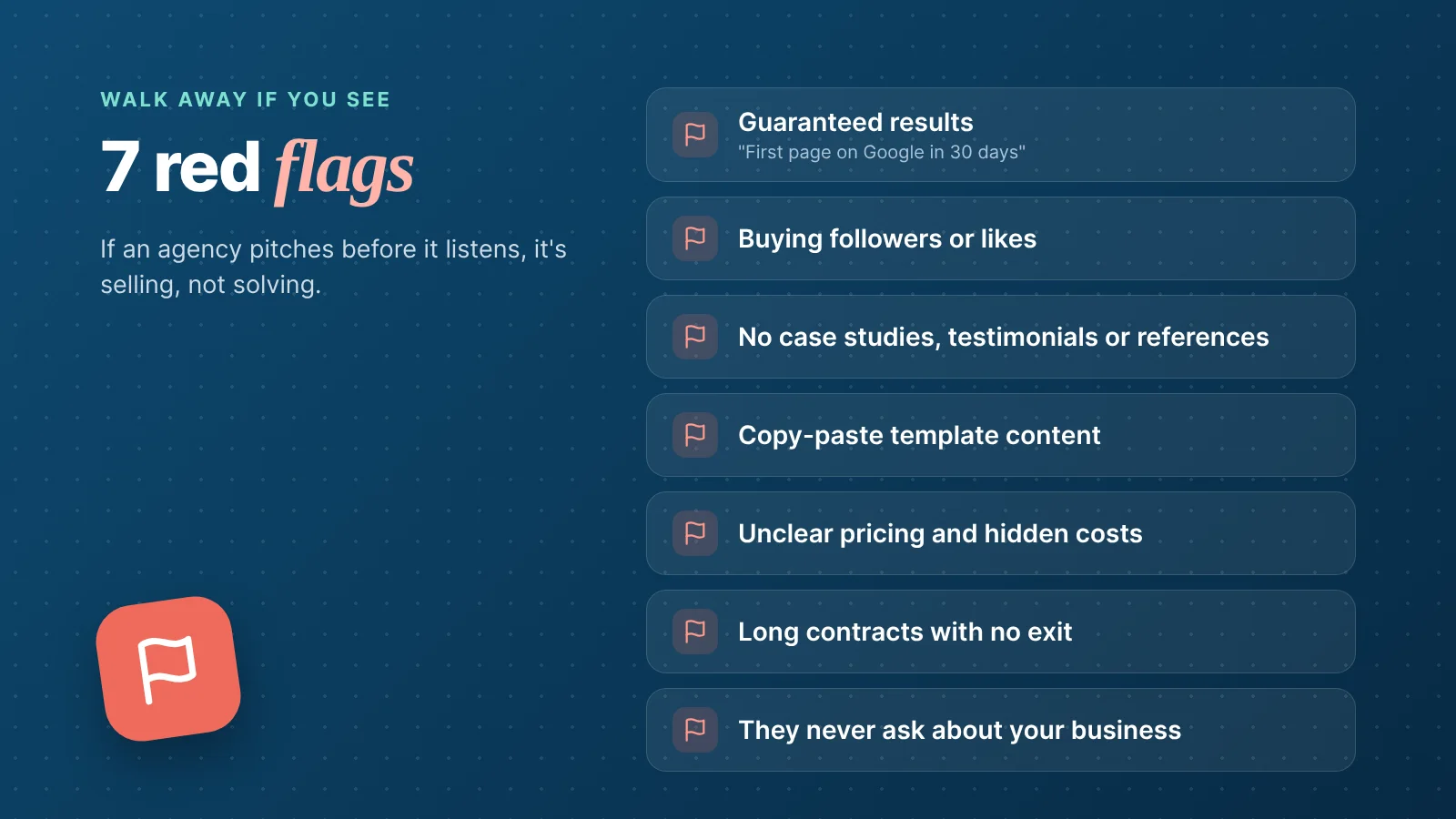
    7 red flags to walk away from when choosing a digital marketing agency
    • Guaranteed results. “First page on Google in 30 days” or “10,000 followers guaranteed.” No honest agency can guarantee this.
    • Buying followers or likes. It inflates numbers and damages your reach.
    • No proof. No case studies, no testimonials, no references.
    • Copy-paste content. The same template designs are used for every client.
    • Unclear pricing. Hidden costs that appear after you sign.
    • Long contracts with no exit. Especially before any results.
    • They don’t ask about your business. If they pitch before they listen, they’re selling, not solving.

    Digital marketing agency comparison checklist

    Before you sign a contract, use this checklist to evaluate your shortlisted agencies. Look beyond pricing and promises to understand what each agency will actually deliver.

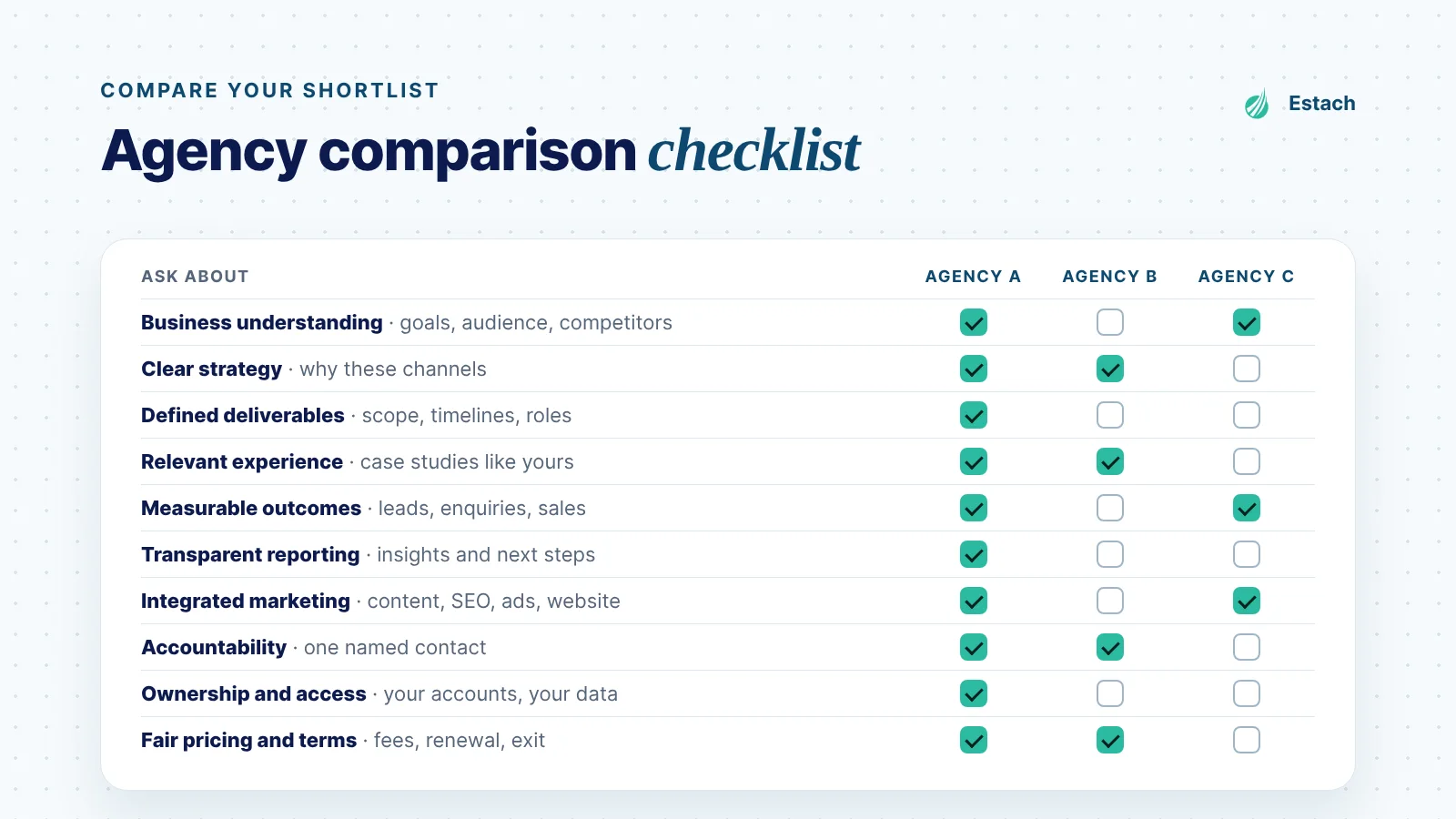
    Digital marketing agency comparison checklist for evaluating shortlisted agencies

    Use these questions to assess each agency before making your decision.

    • Business understanding: Has the agency taken the time to understand my business, target audience, competitors and goals?
    • Clear strategy: Can it explain why it recommends specific marketing channels and how they support my objectives?
    • Defined deliverables: Are the scope of work, timelines, content requirements and responsibilities clearly documented?
    • Relevant experience: Can it share case studies or examples relevant to my industry or business goals?
    • Measurable outcomes: Has it defined meaningful KPIs, such as qualified leads, enquiries, conversions or sales?
    • Transparent reporting: Will I receive regular reports that explain performance, insights and next steps?
    • Integrated marketing: Can it connect content, social media, SEO, paid campaigns and website activity where needed?
    • Accountability: Do I know who will manage my account and whom to contact when I need support?
    • Ownership and access: Will I retain access to my advertising accounts, website, analytics and marketing assets?
    • Fair pricing and terms: Are fees, ad spend, contract duration, renewal terms and exit conditions clearly explained?

    Before you make your decision

    Don’t choose an agency simply because it offers the lowest price or promises the fastest results. Choose one that understands your business, explains its approach clearly and connects marketing activities to outcomes that matter to you.

    Why choose Estach

    We built Estach around the questions above, because we’ve seen what happens when agencies skip them.

    • Strategy first, execution second. We align on goals, audience and content direction before anything goes live.
    • Proof, not promises.
      • Healthcare: 1.5M+ video impressions in 90 days.
      • Construction & Real Estate: 30+ organic leads through content.
      • A local school: average video views up from under 1,000 to over 5,000.
    • Your full digital team. Strategy, scripting, design, video, editing, campaigns, SEO and web development, under one roof.
    • Minimal time from you. We handle the heavy lifting so you can run your business.
    • Clear reporting. You’ll always know what we did and what it delivered.

    We work with healthcare providers, builders, schools, local brands and service businesses across Chennai, Coimbatore and Madurai.

    Not sure where to start?

    Book a free 30-minute discovery call with Estach, or call us at +91 91506 60660. We’ll take the time to understand where your business stands today, identify opportunities for growth, and explore how the right digital marketing strategy can help you move forward.

    Frequently asked questions

    How do I choose the best digital marketing agency in Chennai?

    Look for proven results in your industry, a strategy-first approach, clear monthly deliverables, transparent pricing and reporting tied to your business goals. Ask for case studies and speak to an existing client before signing.

    How long does digital marketing take to show results?

    Social media visibility can improve within weeks. Consistent leads usually take 3 to 6 months of steady work. SEO typically takes longer. Be cautious of anyone promising instant results.

    Should I hire a freelancer or an agency?

    A freelancer can work for a single task, like designing posts. If you need strategy, content, video, ads and a website working together, an agency with a full team is usually more reliable and consistent.

    Do I need to give the agency a lot of time?

    Not if the agency is well organised. A good partner plans shoots and approvals around your schedule. Many of our clients spend only a few hours a month with us.

    Can a digital marketing agency guarantee results?

    No ethical agency can guarantee rankings, followers or sales, because platforms and markets change. What a good agency can promise is a clear strategy, consistent execution and honest reporting.

  • Video Editor (Intern)

    About the Role

    We’re looking for a Video Editor Intern to learn how to cut and polish reels, ads and long-form video content for clients across healthcare, real estate, retail and eCommerce. You’ll work closely with our content and social team and get hands-on experience editing for real client accounts.

    What You’ll Do

    • Assist in editing reels, shorts and long-form video content for client social media and ad campaigns
    • Learn to add captions, motion graphics, sound design and color grading
    • Support videographers and content writers with raw footage organization
    • Help manage project files and version history across client accounts
    • Learn to work within brand guidelines and tight turnaround times

    What We’re Looking For

    • 0-1 years of experience, freshers welcome
    • Basic knowledge of editing tools like Premiere Pro, CapCut or DaVinci Resolve
    • An interest in pacing, timing and storytelling
    • Eagerness to learn and take feedback
    • Comfortable working across multiple projects and formats

    Nice to Have

    • Any personal reels, edits or portfolio work
    • Interest in motion graphics or After Effects
    • Basic videography experience
  • Content Writer & Videographer (Intern)

    About the Role

    We’re looking for a Content Writer & Videographer Intern to learn how to write and shoot content for clients across healthcare, real estate, retail and eCommerce. You’ll work closely with our content and social team to build real, hands-on experience on live client accounts.

    What You’ll Do

    • Assist in writing copy for websites, ads and social media posts
    • Help shoot and plan video content for client social media accounts
    • Learn how to adapt tone and messaging across different client brands
    • Support the team with research, scripting and basic editing tasks
    • Learn to work within brand guidelines across multiple accounts

    What We’re Looking For

    • 0-1 years of experience, freshers welcome
    • Strong writing skills and an interest in storytelling
    • Basic comfort shooting video on a phone or camera
    • Eagerness to learn and take feedback
    • Comfortable working across multiple client accounts and formats

    Nice to Have

    • A personal blog, portfolio or social media content you’ve created
    • Basic video editing skills
    • Interest in healthcare, real estate or retail content
  • Web Developer (Intern)

    About the Role

    We’re looking for a Web Developer Intern to learn how we build, maintain and optimize websites and landing pages for our clients across healthcare, real estate, retail and eCommerce. You’ll work closely with our development team and get hands-on experience with real client projects.

    What You’ll Do

    • Assist in building and maintaining client websites and landing pages using WordPress and modern front-end tools
    • Help implement designs handed off from our design team
    • Learn to optimize page speed, Core Web Vitals and mobile responsiveness
    • Support the team with basic bug fixes and maintenance requests
    • Learn to set up tracking, forms and basic integrations

    What We’re Looking For

    • 0-1 years of experience, freshers welcome
    • Basic understanding of HTML, CSS and JavaScript
    • Eagerness to learn WordPress and PHP
    • Comfortable working across multiple tasks and projects
    • An eye for detail and a willingness to ask questions

    Nice to Have

    • Any personal or academic projects using Next.js or React
    • Familiarity with page builders (Elementor, Divi)
    • Basic understanding of SEO fundamentals
  • Video Editor

    About the Role

    We’re looking for a Video Editor to cut and polish reels, ads and long-form video content for clients across healthcare, real estate, retail and eCommerce. You’ll work closely with our content and social team to turn raw footage into scroll-stopping, on-brand videos.

    What You’ll Do

    • Edit reels, shorts and long-form video content for client social media and ad campaigns
    • Add captions, motion graphics, sound design and color grading to match brand guidelines
    • Collaborate with videographers and content writers to plan edits from raw footage to final cut
    • Organize and manage raw footage, project files and version history across multiple client accounts
    • Deliver edits on tight turnarounds while maintaining consistent quality

    What We’re Looking For

    • 1-3 years of experience editing video for social media, ads or brand content
    • Strong command of editing tools like Premiere Pro, CapCut or DaVinci Resolve
    • An eye for pacing, timing and storytelling that keeps viewers watching
    • Comfortable working across multiple client projects and formats (reels, ads, YouTube)
    • Basic understanding of what performs well on Instagram, YouTube Shorts and Meta ads

    Nice to Have

    • Experience with motion graphics or After Effects
    • Basic videography or shooting experience
    • Familiarity with healthcare, real estate or retail client work
  • Content Writer and Videographer

    About the Role

    We’re looking for a Content Writer and Videographer who’s equally comfortable behind a keyboard and behind a camera. You’ll write copy for websites, ads and social posts, and shoot video content for the same client accounts, healthcare, real estate, retail and eCommerce brands across Tamil Nadu.

    What You’ll Do

    • Write website copy, ad copy, blog posts and social captions across multiple client accounts
    • Plan and shoot video content on-site at client locations across Chennai, Coimbatore & Madurai
    • Work with the social media strategist on each account to plan a weekly content calendar
    • Adapt tone and messaging to fit each client’s brand and industry
    • Collaborate with designers and editors to turn raw footage and drafts into finished content

    What We’re Looking For

    • 1-3 years of experience writing for brands or agencies, plus hands-on shooting experience
    • A portfolio of published writing and video work you can show us
    • Comfortable shooting on a phone or basic camera, including on-site visits
    • Strong grasp of grammar, tone and brand voice
    • Ability to juggle multiple client accounts and deadlines

    Nice to Have

    • Experience writing for healthcare, real estate or retail brands
    • Basic video editing skills (CapCut, Premiere Pro)
  • Web Developer

    About the Role

    We’re looking for a Web Developer to build, maintain and optimize websites and landing pages for our clients across healthcare, real estate, retail and eCommerce. You’ll work closely with our design and marketing teams to ship fast, SEO-friendly pages that actually convert.

    What You’ll Do

    • Build and maintain client websites and landing pages using WordPress and modern front-end tools
    • Implement designs handed off from our design team with pixel-level accuracy
    • Optimize page speed, Core Web Vitals and mobile responsiveness
    • Set up tracking, forms and basic integrations (CRM, WhatsApp, analytics)
    • Troubleshoot bugs and handle ongoing maintenance requests across multiple client sites

    What We’re Looking For

    • 1-3 years of experience building websites, ideally with WordPress and PHP
    • Solid HTML, CSS and JavaScript fundamentals
    • Comfortable working across multiple client projects at once
    • An eye for detail, pixel differences and broken layouts bother you
    • Basic understanding of SEO and page performance best practices

    Nice to Have

    • Experience with Next.js or React
    • Familiarity with page builders (Elementor, Divi) and common WordPress plugins
    • Experience with eCommerce platforms (WooCommerce, Shopify)
  • Content is King Not the Algorithm

    Content is King Not the Algorithm

    Stop blaming the platform. Here’s what actually gets your videos seen and it’s not what most marketers think.

    Content is King Not the Algorithm

    Why Didn’t My Post Reach Anyone?

    You’ve been there. You spend hours making a video. You research the right hashtags, post at the “perfect” time, and follow every tip from every YouTube tutorial about beating the algorithm.

    And then… nothing. 200 views. Maybe 300. Mostly from your friends or who accidentally clicked it.

    So naturally, you blame the algorithm.

    “Instagram is suppressing small creators.”

    “YouTube is pushing only big channels.”

    “The algorithm doesn’t want me to grow.”

    Here’s the uncomfortable truth: The algorithm isn’t your enemy. Weak content is.

    And I’m going to prove it.

    A family from a tiny village in Tamil Nadu with zero marketing budget, zero algorithm knowledge, and zero algorithm tricks, hit 5 billion views on YouTube. No hacks. No paid boosts. Just content.

    Still think the algorithm is holding you back? Let’s dig in.

    The Reality: Algorithms Reward Behaviour, Not Content Type

    Here’s what most digital marketers get completely wrong about algorithms.

    They think the algorithm is some mysterious gatekeeper that randomly decides who gets views and who doesn’t.

    It’s not. It’s actually a lot simpler and a lot more fair than that.

    Every major platform YouTube, Instagram Reels, Facebook, LinkedIn runs on the same core logic:

    The algorithm’s only job is to keep users on the platform as long as possible. It promotes whatever content makes people STAY and ENGAGE. That’s it.

    So how does it decide what to push? It watches how people behave when they see your content.

    1. Watch Time

    Did people watch your entire video or did they drop off in the first 5 seconds? Long watch time = the algorithm pushes you to more people.

    2. Saves & Shares

    When someone saves your post or shares it to their story that’s a massive signal. It tells the platform: “This content was worth keeping.”

    3. Comments & Replies

    Surface level likes mean little. Real conversation in the comments? That’s the algorithm’s green light to reach new audiences.

    4. Click Through Rate

    Did your thumbnail and title make people click? A high CTR tells the algorithm your content is worth recommending.

    Notice: what’s missing from that list? Posting time. Hashtag count. Caption length. How often you post.

    None of that matters if people aren’t engaging. And people only engage with one thing: good content.

    Good content generates saves, shares, and watch time. Good content triggers the algorithm to push you.

    Weak content generates nothing.

    The algorithm doesn’t suppress your content. Your content suppresses itself by giving people no reason to watch, share, or come back for more.

    Same Platform, Different Results Here’s Why:

    This is the part that should make everything click.

    Two creators. Same platform. Same algorithm. Completely different results.

    Sound familiar? Let me show you the clearest example of this and it comes straight from Tamil Nadu.

    Village Cooking Channel Pudukkottai, Tamil Nadu:

    A family from a village called Chinna Veeramangalam in Pudukkottai decided to put their grandfather, a former caterer named M. Periyathambi in front of a basic camera and let him cook. Outside. In an open field. On a wood fire.

    No studio. No ring lights. No DSLR. No algorithm research.

    Just a thaatha, a big vessel, and food cooked the way it’s been cooked for generations.

    The result?

    • 30 Million+ YouTube Subscribers
    • 300 Million views on a single Watermelon Juice video
    • First Tamil YouTube channel to receive the Diamond Creator Award

    Meanwhile, hundreds of cooking channels with professional studios, paid editors, fancy titles, and daily posting schedules are still struggling to cross 1 lakh subscribers.

    Why did VCC win? Because their content made people feel something. It reminded Tamil viewers of their grandmother’s kitchen. The smell of firewood. The sound of a heavy ladle hitting a massive vessel of curry gravy.

    That feeling made people watch the full video. Share it with their amma. Save it to show their kids.

    That’s not the algorithm working. That’s content doing its job.

    The algorithm didn’t find Village Cooking Channel. The content pulled the audience in and the audience told the algorithm what to do.

    So What Actually Works? Here’s Your Real Playbook

    Forget the algorithm tricks. Here’s what actually moves the needle especially for video content in digital marketing.

    1. Storytelling Beats Information Every Time

    Think about the last video you watched fully till the end. Chances are, it told you a story not just facts.

    Here’s a simple example. You’re selling a skincare product. You can say:

    “This moisturiser has 5% niacinamide and hyaluronic acid.”

    Or you can say:

    “Three months ago my skin was terrible dry, patchy, embarrassing. Then I tried this one thing every night for 30 days. Here’s what happened.”

    Both are about the same product. But only one makes you want to keep watching.

    That’s the power of video storytelling in digital marketing. Whether you’re selling, informing, or educating, wrap it in a story. Always.

    Practical tip: Start every video with a problem your audience already has. Then solve it. That structure alone will double your watch time.

    2. Relatability is Your Greatest Distribution Tool

    You know why Amul has been winning at content marketing since 1966?

    Because every single post, every topical cartoon, every butter pun makes every Indian smile and say “haan yaar, this is so true.”

    That relatability is what makes people share. And shares are the highest value signal you can give any algorithm.

    But here’s the real insight: relatability is also how you find your target audience.

    You don’t need to make content for everyone. You need to make content so specific, so “this is literally my life,” that your exact audience feels like you made it just for them.

    A finance creator making content for “first time investors who are scared of the stock market” will always outperform one making content for “everyone who wants to make money.”

    Niche down. Get specific. Get relatable. Your audience will find you.

    3. Value Driven Content, But Not Just “Information”

    Here’s a myth that trips up a lot of digital marketers: “Educational content = valuable content.” Not always.

    Value in video content isn’t just about teaching someone something. Value is anything that improves how someone feels after watching your video.

    • Made someone laugh? That’s the value.
    • Made someone feel understood? That’s the value.
    • Taught someone a skill? That’s the value.
    • Inspired someone to try something? That’s the value.

    Look at the content types that win in video marketing today:

    • Funny / Entertaining – Informative content delivered with humour. Works great for product marketing.
    • Educational – Step by step or how to content. Works best tied to a problem viewers face right now.
    • Relatable / POV – Huge engagement driver. Makes viewers say “this is literally my life.”
    • Behind the Scenes – Raw, unpolished BTS content builds massive trust with your audience.
    • Emotional / Inspirational – Stories of struggle and success. Amul’s COVID campaign won this way.

    The key insight? There is an audience for every type of content. The question isn’t “what type should I make?” it’s “Who am I making this for, and how should I convey it to them?”

    A financial advisor can teach the same concept as an entertaining skit, a serious explainer, a BTS vlog, or a bold hot take. Each format attracts a different segment of their target audience. The topic is the same. The delivery makes all the difference.

    Your content strategy isn’t: “What should I post?” It’s: “Who is my audience and what is the best way to deliver value to THAT specific person?”.

    Conclusion:

    The algorithm is not your enemy. It’s actually on your side and it is actively looking for content to promote. It wants to find the next viral video. It wants to push content that keeps users hooked.

    Your only job is to give it a reason to.

    Make content that hooks people. Tell a story they want to finish. Deliver value that makes them save and share. Create something so relatable that they tag their friends in the comments.

    Do that consistently and the algorithm will do the rest. Every single time.

    A family from Pudukkottai proved it with a wood fire and a basic camera. Amul has proved it since 1966 with a cartoon butter girl. You don’t need to crack the algorithm. You need to create content worth cracking for.

    Stop chasing the algorithm. Start obsessing over your audience. The rest will follow.

  • Digital Marketing for Healthcare in Chennai: Why Clinics & Hospitals Need Digital Marketing

    Digital Marketing for Healthcare in Chennai: Why Clinics & Hospitals Need Digital Marketing

    Digital Marketing for Healthcare

    The past ten years have brought significant changes to the healthcare system.

    People used to stay away from hospitals and clinics until they actually became sick. People would visit their family doctor for all their medical needs because that doctor had complete knowledge of their family’s health history.

    The current situation differs from the past situation in significant ways. People have started looking for specialists. And now it has become even more precise — they want super specialists. A doctor today is not just a doctor anymore.

    The medical profession now includes many different types of specialties which include orthopedic specialists and pediatric specialists and fertility specialists and neurologists and gastroenterologists and other specialists.

    Patients today don’t just choose a doctor based on a recommendation.

    Patients investigate doctors in depth. Patients evaluate hospitals based on their internal atmosphere and their level of cleanliness and their procedures for maintaining hygiene and their physical facilities and their total patient experience throughout all hospital functions.

    Hospitals and clinics need to improve their facilities because they want to provide better care to patients. The healthcare system includes multi-specialty hospitals and super-specialty clinics which combine modern design elements with advanced medical equipment to create clean and functional treatment spaces.

    Healthcare providers are investing heavily to give patients the best treatment environment. Many hospitals and clinics still fail to fulfill one critical requirement.

    Reaching the People:

    Doctors are upgrading to super specialties. Hospitals are upgrading to multi specialty facilities. Hospitals still use outdated techniques to connect with their patients.

    How will that work in today’s world?

    The healthcare discovery process has undergone a complete transformation. People use online tools to locate doctors.

    Patients begin their search by using :

    • Google.
    • They check Google reviews.
    • They visit Instagram pages.
    • They watch videos explaining treatments.

    Hospitals and clinics that appear first in these searches receive automatic attention. People in the digital world tend to trust those who provide explanations before all others. Healthcare marketers use digital marketing techniques to achieve their goals.

    Trust – The Core of Healthcare:

    The Core of Healthcare Trust represents the most important aspect of healthcare. Trust.

    Patients must feel that the doctor understands their condition fully and has the expertise to treat it.

    Patients need to trust doctors who will be able to treat their medical condition. The patient trust relationship takes shape when the patient enters the hospital.

    The process begins before that online. Patients start trusting doctors when they watch health explanation videos and read health content and see doctors in search results and social media.

    Social media presence and search engine visibility (SEO) form the main basis for establishing credibility today. Clinics and hospitals in Chennai use digital marketing to establish patient trust through their online presence.

    How EstacH Helps Healthcare Providers:

    EstacH believes that healthcare providers should have a digital presence which matches their actual medical expertise. Healthcare digital marketing is very different from retail marketing.

    Healthcare marketing needs specific content and visibility through search results to achieve success.

    A person will not simply trust a doctor with their health without feeling confident about the doctor’s credibility and expertise. In retail businesses, customers buy products without emotional attachment.

    Patients enter healthcare services with emotional baggage. Healthcare services need to present themselves as expert dialect services and trustworthy consultation services and dependable medical knowledge services.

    EstacH recognizes the emotional challenges and doubts patients experience when they seek healthcare solutions. Our healthcare digital marketing strategies use patient trust and educational content and credibility as their primary focus points.

    We help hospitals and doctors to establish complete online communication with their patients.

    We create meaningful content for clinics and hospitals so patients can understand the doctor’s expertise and the services they offer. We help clients improve their search presence in online spaces.

    Proper search intent and SEO strategies enable patients to find the right healthcare provider when they look for treatments or specialists or clinics.

    Educational videos become another essential component of knowledge delivery.

    Patients gain medical understanding when doctors use simple language to explain medical conditions. Patients build trust through consistent social media presence which helps them become familiar with the dentist over time.

    The healthcare sector needs to maintain clear communication at all times. Medical professionals must use plain language to explain complicated medical terms to patients who will be hearing those terms.

    Healthcare communication also requires translating complex medical terms into language patients can easily understand. Healthcare organizations can establish patient trust through their online presence by creating clear content which improves their search visibility and maintains communication with patients.

    The competition among healthcare providers in Pallikaranai and Velachery and Medavakkam and Perungudi and OMR areas has risen because new hospitals and clinics have opened in those regions.

    A strong digital presence helps clinics and hospitals stand out and reach patients who are actively searching for healthcare services nearby. Digital marketing for healthcare in Chennai serves as a potent growth strategy which enables healthcare organizations to expand their reach.

    The Goal of Healthcare Digital Marketing

    The goal of digital marketing for healthcare clinics and hospitals is to establish their online presence. The power of digital marketing for healthcare in Chennai.

    Frequently Asked Questions

    Why is digital marketing important for clinics and hospitals in Chennai?

    Digital marketing helps clinics and hospitals become visible when patients search online for medical services. With strong search visibility, social media presence, and educational content, healthcare providers can build trust and attract the right patients.

    How can hospitals attract more patients through digital marketing?

    Hospitals can attract more patients by improving their Google search visibility, optimizing their Google Business profile, sharing educational medical content, and maintaining a consistent social media presence.

    What is healthcare digital marketing?

    Healthcare digital marketing focuses on building trust and credibility for doctors, clinics, and hospitals through search engine optimization (SEO), social media content, patient education, and online visibility.

    Why is SEO important for healthcare providers?

    SEO helps healthcare providers appear in search results when patients search for treatments, specialists, or hospitals nearby. This increases visibility and improves patient inquiries